Sunday, September 11, 2011

Sue Chenette: A trip to Bastille market

Beginning this week, our friend, Toronto poet Sue Chenette, will be the guest diarist of Almost A Week In Paris. Today’s post from Sue:


Here’s a collage of this morning’s trip to the Bastille market. Steve and I almost didn’t go. It was raining. And most of the morning had already slipped away. True, we said, we needed apples and cheese and bread and flowers, but we could always stop by Monoprix tomorrow. Finally, we did rouse ourselves, gathered umbrellas and shopping bags. And if we hadn't gone—I would have missed the man with the black umbrella, carrying a paper-wrapped bouquet of purple gladiolas!
Sue Chenette is the author of three chapbooks: The Time Between Us, A Transport of Grief, and Solitude in Cloud and Sun.

Slender Human Weight (Guernica Editions, 2009) is her first full-length collection; it was a Long-List Finalist for the ReLit Awards in 2010.

Monday, January 17, 2011

Day 6: Sunday, June 13, 2010


Yesterday, we meandered through the Left Bank (La Rive Gauche), the buildings at the University of Paris-Sorbonne, the narrow cobblestone-covered street of rue de la Huchette, past the bookstores selling second-hand books on the sidewalks.


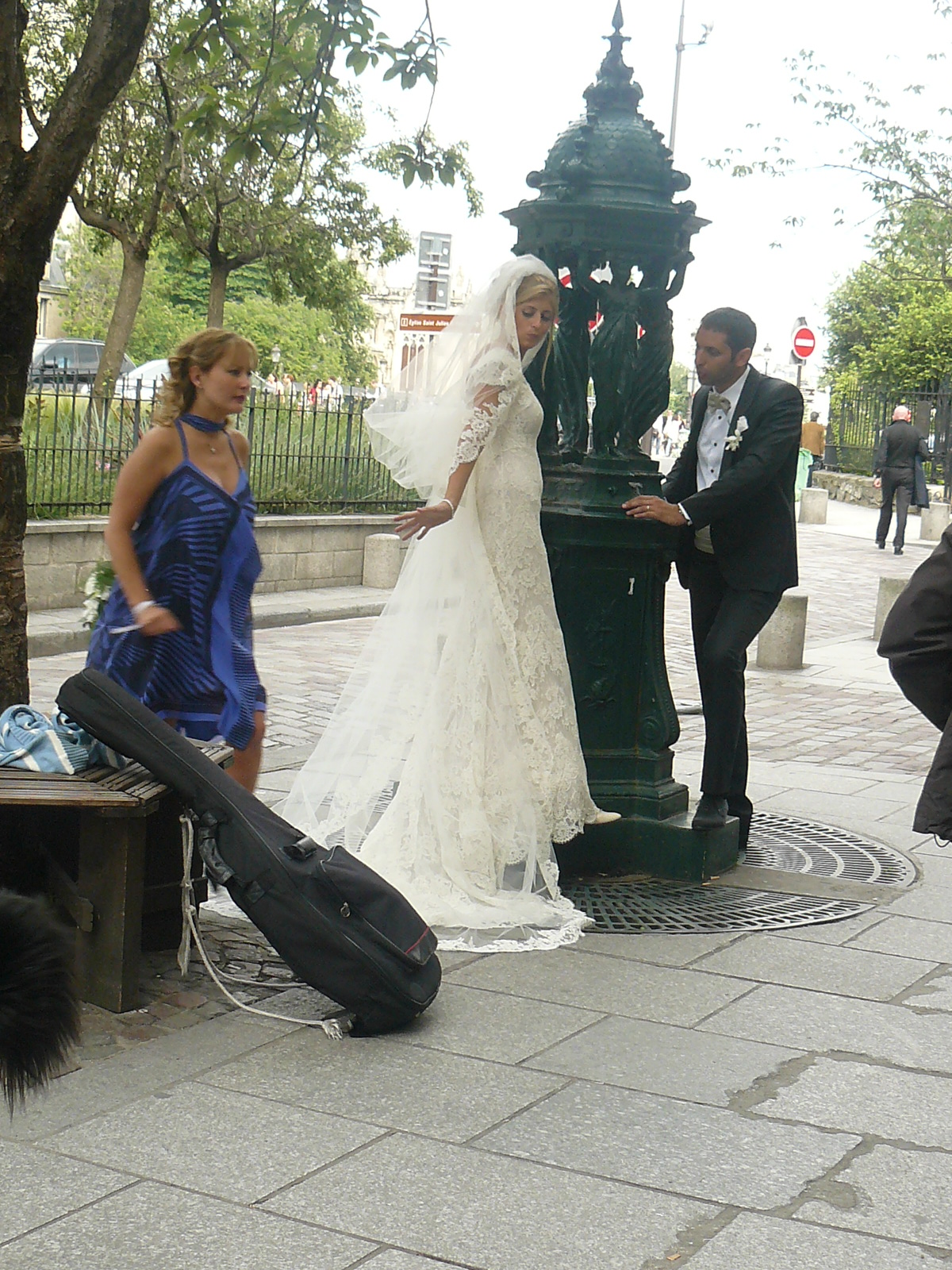
At the Shakespeare and Co. bookstore on rue St. Michele, across from the Notre Dame Cathedral, we watched a newlywed couple traipse in front of the store for their photo shoot.


Poodles and their masters nonchalantly sauntered by the bookstore made famous by American novelist Ernest Hemingway way before everyone called him Papa Hemingway, and prior to his infamous tiff with Gertrude Stein. Shakespeare and Co. is now all of two stores: the smaller store selling first edition books, and other, the regular trade and hardbound books in English.


We crossed the double-decked wood-and-stone-carved bridge to get to the Notre Dame Cathedral. The scene in the square yard called place Parvis with its assortment of tourists and pilgrims appeared far more fascinating than the rose windows and flying buttresses of the famed church. Here, people congregated, bantered and chatted as if waiting for a procession or a spectacle to proceed. It seemed as if time stood still and people didn’t care to lose precious hours, as in Marcel Proust’s Remembrance of Things Past. The present as tangible as the minutes and the hours of years past, the now to be savoured and quaffed in an afternoon at the plaza.


Everywhere we went, whether at the open cafes and boulevards, or the numerous watering holes and fountains in the city, there was a joyful abundance of time to spare because after all, this is the city that gave birth to the promenade, the tryst and the dalliance, a city that gave Robert Doisneau’s “The Kiss” a home. In fact, we still hang a replica of the famous photo in our house in Toronto, taken in Le Baiser de L’Hotel de Ville in 1950, some sixty years ago. Who would think that we would visit this same town hall and square in our lifetime?


And yes, we did get lost, finally, as we were walking past Hotel de Ville, looking for the street closest to flat where were staying. We circled the Les Halles, former site of the oldest grocery in the world, now an underground mall, green space and Metro station, with its cavernous alleyways, deep tunnels that reached out to nowhere.


My daughter had warned us not to take this Metro station because of its numerous and dizzying stairwells and exits, but since we couldn’t find the street back to our flat, we went round and around, taking the Metro even if our street was just a block away from the plaza where we lost our way in the first place. It took us almost an hour and a half but we did get home, très fatigué, and ready to succumb to fitful sleep.


Three places we missed

There were three places we missed looking up because we didn’t have enough time to visit.

Northward, the Musee Picasso, on 5 rue de Thorigny, in the 3rd Arrondisement, is housed in Hotel Sale, and boasts a huge selection of Pablo Picasso’s works, including pieces of work by artists who influenced him.

Musee Nissim de Camondo at 63 rue Monceau, in the 8th Arrondisement, is famous for its collection of 18th century decorative arts (paintings, tapestries and porcelain) and the tragic story of the Comte Moise de Camondo family. Built in 1911-1914 along the model of the Petit Trianon at Versailles, it became a museum dedicated to the memory of the Comte’s son, Nissim, who died in aerial combat in 1917.

Also called the Beauborg, the Centre National d’Art et de Culture Georges Pompidou on 4th Arrondisement (M. Rambuteau), is a cultural centre embracing music, cinema, books, and graphic arts. Its main draw, the Musee National d’Art Moderne, houses a rich collection of 20th century art, from the Fauves to the Cubists to Pop and Conceptual Art. The building is turned inside-out, with piping and ventilation ducts in blue, red, green and yellow running up and down its walls: front, side and back.


We finally caught a view of the Centre Pompidou when we took a stroll after having lunch with Isobel and Steve at Au Pied du Cochon (6 rue Coquilliere), a French restaurant on the 1st Arrondisement, known for their onion soup and pig’s feet grilled and served with béarnaise sauce. Our waiter was polite and obliging, and even treated us for free coffee after he accidentally spilled some wine on Joe’s coat. The damage was discernible, but the waiter thought it was the least he could do. The crème brûlée has never tasted better with coffee on the house.


Off we went to Le Marais on the 4th Arrondisement, for a quick visit to the boutiques and boîtes, and rue des Rosiers, the main street of the Jewish Quarter, with its Middle Eastern and Eastern European specialty stores, falafel stands, crêperies, galleries and restaurants.


Isobel, who was meeting her friend and classmate Miguel at a café in the Place de Vosges, sent us gallery-hopping again in this architectural landmark built in 1612, two years after Henri II died there in a jousting tournament: 36 buildings with arcades on the street level, and facing a public square which used to be the site of a horse market.


We sat in one of the wooden benches shaded by a row of chestnut trees and watched the world go by. Across from us were the once-upon-a-time grand parlours where Moliere, Racine and Voltaire exchanged bon mots.


Will we ever go back and revisit Paris after this scintillating week tripping into the unknown?


In a heartbeat!


There was so much to savour: the sights and sounds, the tastes and smells, the hidden and the not-so-hidden parts and places closest to the human heart. To extend a second to the minutest so its atomic particles will fill an hour with whole lifetimes—this was what Parisians had accomplished in building and rebuilding their city through the various upheavals that had marked their history. We can only thank them for sharing their art and culture with the rest of the world: the tragic, the haunting, the comic, the ugly, the beautiful, the sad as well as the unique places and landmarks that make Paris both a dreamer’s and a wanderer’s paradise.

Sunday, January 16, 2011

Day 5: Saturday, June 12, 2010

Saturday and we would be on our own, exploring the nooks and crannies, the bowels of Paris, above and below, and in between.

Since last Wednesday’s sudden downpour, I had been nursing a slight cold and was coughing a bit. So before launching on our trip to the Arc d’Triomphe and Eiffel Tower west of the city, we went to look for a pharmacy in one of the streets on route.

It turned out to be quite a trip to the streets past the Palais Royal, formerly known as the Cardinal’s Palace because it was built by Cardinal Richelieu, appointed First Minister by Louis XIII, in the mid 1600s. On his deathbed, the Cardinal willed the estate to the King, thus the name Palais Royal. Only a fragment of the palace survives; now the Comedie Francaise and the Palais Royale Theatre form part of the complex. Moliere, acting there in one of his own plays, Le Malade Imaginaire (The Imaginary Invalid), collapsed on the stage in 1673, and died shortly thereafter.

On July 13, 1789, at now-gone Café Foy in the Palais Royal, Camille Desmoulins jumped up on a table and shouted for the mob to fight to the death, marking the start of the French Revolution.

As we exited the buildings now housing the Ministry of Culture and the State Council, we came across rows upon rows of stunted columns by artist Daniel Buren in the courtyard’s pavement. The columns stood like chess pieces waiting to be moved. We were moved by the artist’s sense of play.


Had we known earlier, we could have looked for the houses of famous people who once lived in the apartments in the area. Along rue Galerie de Beaujolais, on No. 9, facing rue Vivienne, was the home of the novelist Colette. On rue Monpentsier, southward, on No. 36, once lived the artist Jean Cocteau. But since looking for famous people’s homes was not on our agenda, we continued to walk the huge streets past the Opera House, on to Place Vendome (see two photos above), home of the Ritz, Chanel, banks and lux stores in a square dominated by the statue of Napoleon.

Champs-Elysées

To get to the Arc de Triomphe, we crossed the famed rue du Faubourg St-Honoré, home to the big designer houses, and on to the mass market and teen stores along the Right Bank on Champs-Elysées.

The Champs-Elysées was designed by Parisians to indulge in their favourite pastime: the promenade. Part of the walk, we found out, was through a chestnut-lined park, and the rest, along a commercial avenue filled with sidewalk cafes, sports and shoe stores, video and computer outlets, fashion boutiques, and fast-food joints.

Arc de Triomphe

By this time, our feet had swelled with our bunions’ constant pounding of the pavement. But the Arc de Triomphe beckoned just another three hundred metres away, so we persevered.


The Arc was worth the agony of our long walk. It stood like one of those ancient Roman arches about 163 feet high and 147 feet wide, the biggest triumphal arc in the world. It had been commissioned by Napoleon in 1806 to commemorate his victories. It’s now the site of the permanent tomb to France’s Unknown Soldier.


The Eiffel Tower

In 1889 when it was built, the Eiffel Tower, at 981 feet, was the tallest edifice in the world. Although other more modern and much taller towers had been built since then, the Eiffel Tower remains a sight to behold: an open framework construction weighing about 7,000 tons.

We stood underneath the tower and tried to count the two and half million rivets lining the rocket of steel lacework. We stopped counting at 2,010 rivets (in honour of the Year 2010), because by then we were out of breath and choking with awe.


The French know how to project their pride in their roots, heritage and accomplishments. No wonder Albertans claim to be in Canada’s province with the biggest: the world’s largest Ukrainian Easter egg near Vegreville, the world’s largest bee in Falher, the world’s biggest kielbasa sausage in Mundare and the largest softball in Chauvin, to name just a few.


Since we still had plenty of time in our hands, we took the Metro to Montparnasse to visit its famous cemetery. This is where the fun begins. Although the cemetery is replete with landmarks pinpointing the graves of the famous and the infamous, merely using the map won’t bring you nearer or closer to the grave of the famous person you’d be looking for.


The much-sought-after joint grave of Jean Paul Sartre and Simone de Beauvoir, French existentialist philosophers and writers, although marked on the map as located on the centre of the cemetery, wasn’t where it was supposed to be. Instead, the helpful woman custodian on the entrance at avenue Edgar Quinet guided us to the site which was left of the main entrance.


As he searched grave upon grave looking for the famous pairs joint grave, Joe stumbled upon his favourite playwright Eugène Ionescos tomb.

Soon enough, we also found poet Charles Baudelaires tomb on right end side of the cemetery, with some freshly-lain flowers on its well-kept grave.

Standing before these famous peoples graves only brought a twinge of sadness to us; yes, the solitude and insignificance of human existence becomes all the more stark as we encounter death in its abject manifestation, among the tombs of the famous and the-not-so famous. In the end, death puts us on a levelling field, yet even in death, depending on our circumstance, we could be lying under a tomb of marble or hogging space in a common potters field.
Jean-Paul Sartre and Simone de Beauvoir at the Balzac Memorial in 1920s.

Source: Wikipedia