Wednesday, November 2, 2011

Sue Chenette: Underground


According to my very unofficial survey, most expats have a love-hate relationship with the Paris métro. (I suspect Parisians do too.) I remember a cold, grey February conversation with a young American woman who had ras le bol, which is to say, she had had it. “That awful, dirty hole in the ground,” she called it. Sometimes I feel that way too.


That said, descending into the métro, greeted by a particular, cinder-y smell (which John Lichfield, The Independent’s long-serving correspondent in France, has described as “something between burnt air and rotting bananas”), the screech and whoosh and whine of a train entering the station, the chook of the levers that open the doors—this can make me unaccountably happy. (Maybe it's simply that it means, “Paris.”) 


Life underground is a microcosm of Parisian life above ground. Passengers read, converse, busk a living with a trumpet or an accordion, check text messages, embrace, and sleep, in a crowded car that mirrors the space in cafés with their close-packed tables, or the narrow sidewalks where you lift your umbrella over that of the person coming toward you in the rain.


The French are conscious, above or below ground, of what’s required to live together in shared space. They say “Pardon,” and “Excusez-moi,” and make room for your knees when you sit down across from them. And if they forget, they are reminded. This fall, it was impossible to miss the series of posters with a sloth sprawling in a subway seat at rush hour, a chicken in a pink trench coat talking loudly on her cell, a frog jumping a turnstile.


When you take the métro late at night—the crowds gone, maybe two or three other passengers encountered as you transfer from one line to another, following the correspondance signs—the tiled walls, the long corridors with their varied gradients and odd-angled corners, the flights of steps which you climb only to reach a short hallway, turn a corner and descend again: all come into clearer relief, making their claim as structure, the way mountains do at dusk. If I had a cat’s nine lives I might devote one to making a model of the Paris métro, every distance and elevation and angle replicated on a match-stick scale.


When I finished, I would add the stairs that lead to trees and sky.

Thursday, October 27, 2011

Sue Chenette: Salon du Chocolat


“Lessons from Things” is the title of a chapter in Adam Gopnik’s charming and insightful memoir, Paris to the Moon. The phrase, he writes, “refers to a whole field of study, which you learn in class, or used to, that traces civilization’s progress from stuff to things...the passage of coffee from the bean to the porcelain coffeepot, or wine from the vine and soil to the bottle....”


I was thinking about this last Saturday, as we made our way up and down the crowded aisles of the Salon du Chocolat, held in one of the exhibition halls at Porte de Versailles. From cocoa bean to the most sumptuous truffle, from almond to the most delectable macaron, the most delicately flavoured calisson.


But the French don’t stop there. Given “stuff,” they set out to transform it, by dint of imagination, craft, patience and persistence, into fabulously elaborate “things.” A chocolate Arc de Triomphe embedded with 4000 Swarowski crystals. A chocolate Eiffel Tower with macaron cladding. A flower garden of calissons. Chocolate Oxfords.


These are the work of maîtres pâtissiers, the finest of whom, after demonstrating their skill under pressure in a competition held every four years, are privileged to wear the red, white and blue collar awarded to the Meilleurs Ouvriers de France. (Having seen The Kings of Pastry, the 2009 documentary film about the MOF competition, I had great respect for the Monsieur who was chopping up a chocolate accordion and handing out samples.)


Stuff to things. And not just in the realm of food. Think of French gardens, with their sculpted topiaries and geometrical parterres. An impulse to subdue and refine nature. It must trace back to ancient confrontation with a harsh landscape. And to rivalry among princes and kings: my artisan is more clever than yours.


Leaving us the bemused and delighted beneficiaries. Who but the French would conceive of chocolate dresses—a macaron-dotted tutu, a svelte ruched skirt, a bouffant mesh of roses?


Tuesday, October 18, 2011

Sue Chenette: Manif


We found out about last Tuesday’s manif—short for manifestation, the French word meaning demonstration—halfway home from our morning class at Alliance Française.


The bus driver was ordered to turn around and head back to the station because of congestion in the streets ahead. This happens often in Paris. Time to walk, or find the nearest métro.


The French don’t balk at expressing indignation. In my Alliance Française text, one lesson is devoted to appropriate expressions (C’est scandaleux! Mais il est fou!) along with the grammatically proper use of the past conditional tense pour protester.


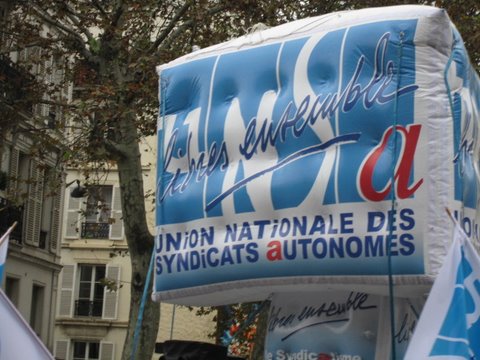
On Tuesday the manifestants from unions and universities were out in full force with banners and balloons, protesting government austerity measures which would mean across-the-board job cuts. The march continued for the two hours that I lingered, with a book and a chocolat chaud, in the corner café where we emerged from the métro. It was festive: crowds and colour and chanting.


Both the marchers and the municipal crew, who follow with their hoses and brooms and leaf blowers for the pamphlets, know their parts well. There’s an established routine. You might almost call it a ritual. You could make the case that the French take to the streets to celebrate the idea of their solidarity, and that the demonstrations accomplish little beyond that. I asked the waiter who brought my check what the demonstration was about. “Je ne sais pas,” he said with a shrug.


On Saturday afternoon, les Indignés (the Indignants) filled the plaza in front of Hotel de Ville, joining in the global Indignant Citizens Movement. I wasn’t there, but I found a video online. I was struck by the absence of banners and balloons. It seemed different. More sober. And left me wondering, could this lead to change?